Skip to content
Congress·In Committee·about 2 months ago

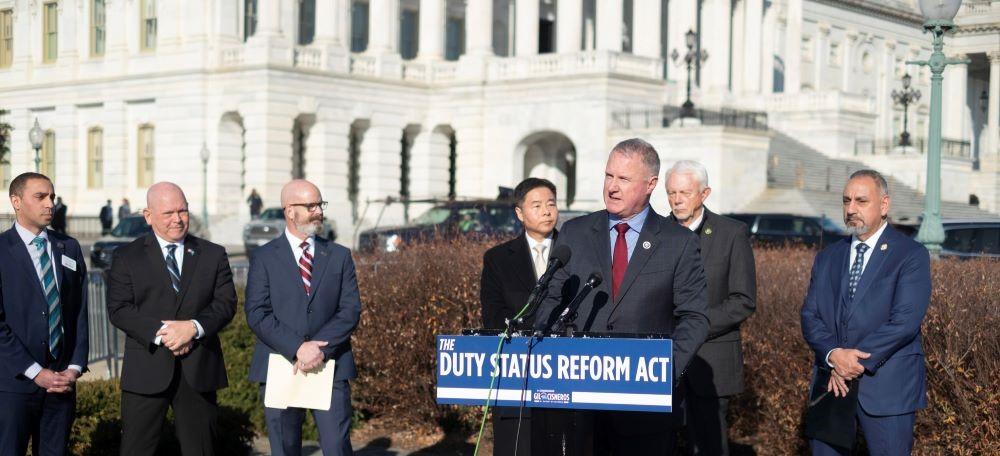
House Panel Reviews Duty Status Reform Act to Streamline Reserve and National Guard Call-Up Rules

Also known as: Duty Status Reform Act

Legislative Progress

Filed
Review
House
Senate
President

Impacts

Mixed Impacts(3)
Military Active
Neutral
Child Tax Credit
Neutral
Small Business Owner
Neutral
Positive Impacts(6)
Federal Employee
Helps
Chronic Illness
Helps
Veterans Benefits
Helps
Retiree
Helps
Student Loans
Helps
Student
Helps

State Impacts

District of ColumbiaDC
Mixed

The bill repeatedly treats the District of Columbia like a “State” for National Guard call-up and duty rules and specifically references the commanding general of the DC National Guard. Practically, DC could see clearer legal pathways for DC Guard duty status and benefits alignment when DC Guard members are ordered to certain duties.

Puerto RicoPR
Mixed

Puerto Rico is explicitly included in multiple places (treated like a “State” for certain Guard authorities) and is listed as a location where National Guard duty/training rules apply. This could matter for Puerto Rico Guard members’ duty status labels and whether certain benefits and protections attach to their orders under the updated system.

GuamGU
Mixed

Guam is explicitly included in the bill’s definitions and location rules for National Guard duty and certain call-up authorities. For Guam Guard members, the practical effect is that the bill’s relabeled duty categories and benefit alignment would apply the same way they do in states, reducing special-case treatment.

Virgin IslandsVI
Mixed

The U.S. Virgin Islands are named in the bill’s definitions and location rules for National Guard duty and certain call-up authorities. This would apply the same reorganized duty categories and aligned benefits framework to Guard members from the Virgin Islands.

HawaiiHI
Mixed

The bill includes a specific education-related rule for National Guard members serving on full-time National Guard duty in Hawaii (and Alaska or Puerto Rico) when they were ordered from a different place. That could affect eligibility for certain Department of Defense dependent education benefits in those cross-location situations.

AlaskaAK
Mixed

The bill includes a specific education-related rule for National Guard members serving on full-time National Guard duty in Alaska (and Hawaii or Puerto Rico) when they were ordered from a different place. This can matter for dependent education benefit eligibility for families in these cross-location duty situations.

Key Points

  • Would reorganize how Congress lets the military put Reserve and National Guard members on different kinds of duty, aiming for clearer rules and fewer overlapping authorities.
  • Creates four duty “categories,” including a new option for remote assignments that can be done on a flexible schedule and location, as long as the work is pre-approved.
  • Sets clearer limits for certain call-ups without a service member’s consent, including caps and time limits tied to the type of emergency and mission.
  • Expands and clarifies when the President can call the National Guard into federal service for domestic crises and when disaster help can use Reserve forces at a governor’s request.
  • Tries to better line up pay and benefits with the type of duty being performed, so service members and families aren’t surprised by what they do or don’t qualify for.
National SecurityVeteransInfrastructureCybersecurity

Milestones

2 milestones2 actions
Jan 8, 2026House

Referred to the Committee on Armed Services, and in addition to the Committees on Transportation and Infrastructure, Oversight and Government Reform, Agriculture, Small Business, Financial Services, the Judiciary, Education and Workforce, Veterans' Affairs, Ways and Means, Homeland Security, and House Administration, for a period to be subsequently determined by the Speaker, in each case for consideration of such provisions as fall within the jurisdiction of the committee concerned.

Jan 8, 2026

Introduced in House

What Happens Next

Projected impacts based on AI analysis

10 years after enactment

Most changes would not start until 10 years after the bill becomes law.

If you are in the Guard/Reserve today, your day-to-day duty labels and benefits likely wouldn’t change right away unless Congress later sets an earlier start date.

Earlier than 10 years, only with new certifications + a new law

Possible earlier start date if Defense Department, Homeland Security, and VA certify readiness and Congress passes another law setting an earlier date.

The new duty categories and benefit alignments could start sooner than 10 years, but only if agencies say they are ready and Congress agrees in a separate law.

Up to 180 days before covered duty begins (after effective date)

Early TRICARE access would begin for covered orders, up to 180 days before the duty start date, once the law’s coverage rules apply.

Families could start using military health coverage earlier when an activation is coming, helping avoid insurance gaps and letting people schedule care sooner.

After the effective date, during rollout period

New “category I–IV” order formats and documentation would roll out across services.

Service members should see orders that more clearly state what the duty is for and which benefits apply, which can help with employers, schools, and insurers.

After the effective date, phased updates

Agencies would update benefit rules and forms that rely on the old duty labels (including education, survivor, and employment protections).

Over time, fewer people should get denied benefits just because their orders used an older authority name, but there may be short-term confusion during the switch.

Related News

2 articles

Source Information

Document Type

Congressional Bill

Official Title

Duty Status Reform Act

Bill NumberHR 6976
Congress119th Congress
ChamberHouse of Representatives
Latest ActionReferred to the Committee on Armed Services, and in addition to the Committees on Transportation and Infrastructure, Oversight and Government Reform, Agriculture, Small Business, Financial Services, the Judiciary, Education and Workforce, Veterans' Affairs, Ways and Means, Homeland Security, and House Administration, for a period to be subsequently determined by the Speaker, in each case for consideration of such provisions as fall within the jurisdiction of the committee concerned.

Sponsor

Cosponsors

(12)
D: 4R: 8

Analysis generated by AI. While we strive for accuracy, this should not be considered legal or professional advice. Always verify information with official government sources.